Every dental practice owner understands that new patients matter. Marketing budgets prove it. What most practice owners do not understand is that recall, the boring, unglamorous process of getting existing patients back in the chair for their next hygiene visit, is where the real money lives.
The math is not complicated, but almost nobody does it. And the practices that do not do it are quietly bleeding six figures in revenue every year without realizing it.
The Recall Gap Nobody Talks About
The industry average recall rate for dental practices sits between 60% and 70%, according to ADA benchmarking data. That means for every 100 patients who are due for a hygiene appointment, 30 to 40 of them simply do not come back on schedule. Some come back eventually. Many never do.
Top performing practices achieve recall rates between 80% and 88%. The difference between a 65% recall rate and an 85% recall rate does not sound dramatic. It is. For a practice with 1,500 active patients, that 20 percentage point gap represents roughly 300 patients per year who either fall out of the schedule or get recovered, depending on which side of the gap your practice sits on.
Now attach revenue to that number. The average hygiene appointment produces $175 to $200 in direct hygiene production. When you include the doctor exam and resulting treatment acceptance, the total visit value reaches $350 to $450. At 300 additional recovered visits per year, the revenue difference between an average recall rate and a top performer recall rate lands somewhere between $105,000 and $135,000 annually.
That is not a marketing expense. That is revenue from patients who already trust you, already have records in your system, and cost almost nothing to bring back compared to acquiring a new patient.
Why Recall Drops Off (and Where the Money Leaks)
Patient attrition in dental practices averages 17% per year. Some sources report a range of 10% to 40%, but 17% is the most commonly cited industry benchmark. Top performing practices keep attrition below 10%.
The compounding effect is brutal. A practice losing 20% of its patients annually will see its patient base cut in half within four years unless it replaces every lost patient with aggressive (and expensive) new patient acquisition. Acquiring a new dental patient costs between $100 and $300 in marketing spend. Retaining an existing one costs a fraction of that.
So where do recalled patients actually drop off? The biggest leakage point is not between the hygiene chair and the door. It is between the door and the next appointment.
Only about 50% of practices manage to book their hygiene patients for their next visit before they leave the office. The top performers get 70% of patients pre-booked. This single metric, same-day hygiene reappointment, is one of the strongest predictors of long-term recall performance. Patients who leave with an appointment on the books show up at dramatically higher rates than patients who leave with a vague "we will call you in six months" understanding.
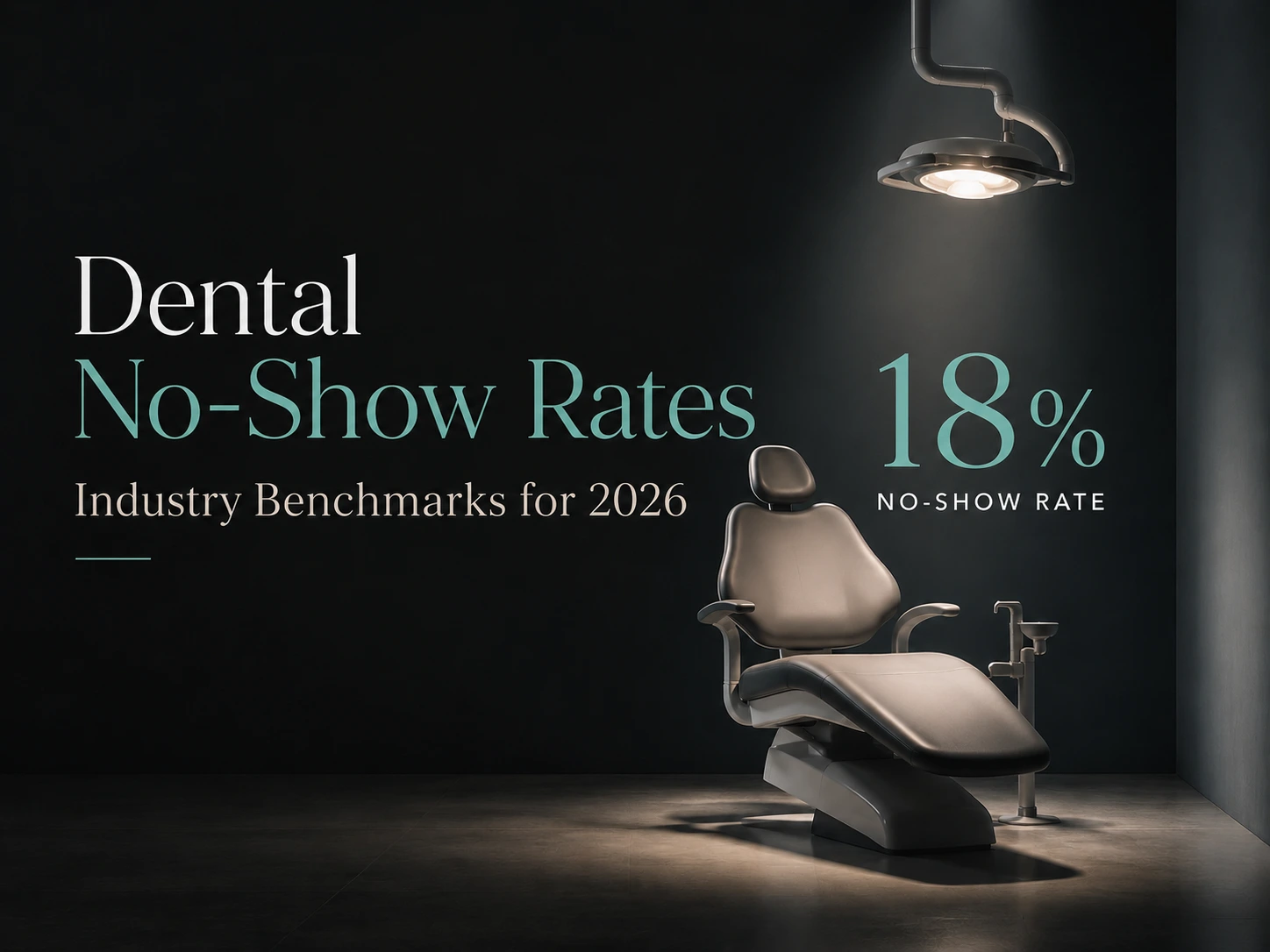
Pre-scheduled recall appointments have a no-show and cancellation rate of 8% to 12%. Patients who are called later and asked to schedule show a 22% to 30% no-show rate. The gap is enormous, and it compounds every recall cycle.
Pre-scheduled recall appointments have an 8 to 12% no-show rate. Patients booked later by phone have a 22 to 30% no-show rate. The booking moment is the single highest-leverage point in the entire recall pipeline.
The Lifetime Value Calculation Most Practices Never Run
A typical dental patient generates $800 to $1,200 per year in recurring production between hygiene appointments, periodic X-rays, and the restorative treatment that gets identified during those visits. Over a 10 year relationship, which is the average tenure for a retained dental patient, that represents $8,000 to $12,000 in lifetime value.
The patient's value actually increases over time. As clinical needs grow with age and as the doctor-patient relationship deepens, case acceptance on recommended treatment goes up. A patient in year eight of the relationship accepts treatment at a higher rate than a patient in year two.
When your recall system fails and a patient drifts away after year three instead of staying for year ten, you are not losing one $200 cleaning. You are losing $5,000 to $8,000 in future revenue from that single patient. Multiply that across the 50 or 100 patients above your expected attrition rate who quietly disappear each year, and you start to see why Henry Schein One has reported that the average dental provider leaves $1 million to $1.5 million per practice in unscheduled treatment sitting on the table.
What Automated Recall Actually Does (and Does Not Do)
Automated dental recall systems handle the operational layer: sending the right message to the right patient through the right channel at the right time, without requiring your front desk staff to manually chase hundreds of overdue patients each month.
The evidence supports their effectiveness. Text message reminders produce a 98% open rate compared to 21% for email. Practices using automated multi-channel recall workflows report recall rates 15 to 25 percentage points higher than practices relying on manual phone calls. And a study across 64 dental practices analyzing over 1.6 million appointments found that automation reduced missed appointments by nearly 23%.
What automation does not do is fix the underlying reasons patients leave. If the hygiene experience is poor, if wait times are excessive, if the patient feels rushed or does not understand why they need to come back, no amount of text messages will keep them in the schedule long-term.
The most effective recall strategies layer automation on top of in-practice fundamentals. BMC Oral Health published a 2024 randomized controlled trial showing that personalized visual oral health education using the patient's own photographs improved clinical outcomes at three months. The mechanism is behavioral: patients who understand the value of their next visit are more likely to keep it. Automation handles the logistics. Education handles the motivation.
On the operations side, this is where tools like WhatsApp Business automation and n8n workflow pipelines become the highest-ROI investments in the practice. The same WhatsApp number that confirms today's appointment can run the 30-day, 60-day, and 90-day overdue sequences without any front desk involvement.
The Recall ROI Formula for Your Practice
Here is how to calculate what better recall is worth to your specific practice.
Take your active patient count (patients seen within the last 18 to 24 months with at least two hygiene visits). Multiply by 2 for the expected annual visit frequency. Divide by 12 to get your expected monthly hygiene volume. Now multiply by your current recall rate and compare it to the volume you would see at an 85% recall rate.
The difference, multiplied by your average per-visit production, is the annual revenue you are leaving on the table.
For a practice with 1,500 active patients at a 65% recall rate producing $400 per visit (including doctor exam production), moving to an 85% recall rate represents an additional $120,000 in annual revenue. The cost of the automated recall system that gets you there is typically $200 to $500 per month.
That is not a close ROI decision. That is an obvious one.
What to Do With This Information
If your recall rate is below 70%, you have a systems problem. Start with same-day pre-scheduling and get your hygiene team trained to make the next appointment before the patient leaves the chair. Layer automated text and email sequences on top. Track the numbers monthly.
If your recall rate is between 70% and 80%, you have an optimization problem. You are doing the basics but losing patients in the gaps. Look at your reactivation workflow for patients who are 30, 60, and 90 days overdue. Automate the outreach with escalating urgency and make rescheduling frictionless through online booking links embedded directly in the reminder messages.
If your recall rate is above 80%, protect it. The practices that maintain 85%+ recall rates do so through systems, not heroics. Document the process, automate everything that can be automated, and measure it relentlessly.
Whatever your current rate is, the first step is quantifying what improvement is actually worth to your bottom line. Calculate your specific recall revenue opportunity in the Dental Practice Calculator.
Sources
- ADA Health Policy Institute, benchmarking data (2024). Industry average dental recall rate 60-70%; top performers 80-88%.
- Planet DDS, 2025 Dental Industry Outlook Report. Operational data from 3,400 dental practices on the Denticon platform. Recall, retention, and same-day rebooking benchmarks.
- Clerri, "Dental Patient Retention Statistics" (2026). Patient attrition averaging 17% annually; range 10-40% across practices.
- Precision Dental Analytics, "Patient Retention and Reappointment Architecture" (2026). Same-day reappointment as the strongest single predictor of long-term recall performance.
- eAssist Dental Solutions, "Hygiene Recall and Recare by the Numbers" (2025). Per-visit production benchmarks for hygiene plus doctor exam ($350-$450).
- BCAT, "Dental Hygiene Recall Rates: The Key DSO Valuation Driver" (2026). Why DSOs underwrite practice valuations using recall rate as a primary input.
- Henry Schein One, unscheduled treatment data. Average dental provider leaves $1M-$1.5M per practice in unscheduled treatment annually.
- ThriveCloud, "6 Metrics That Determine the Success of Your Dental Practice." Same-day rebooking benchmarks across average and top-quartile practices (50% vs 70%).
- BMC Oral Health, 2024 randomized controlled trial on visual oral health education. Improved 3-month clinical outcomes via patient-specific imagery.
- Sesame Communications study, 1,604,184 appointments across 64 dental practices. Automation reduced missed appointments by ~23%.
- Dentx, "Dental Recall Rate Benchmarks" (2026). SMS open rate (98%) vs email open rate (21%).
- CastHub, "Dental Patient Retention and Recall: 2026 Guide." Multi-channel recall sequences vs single-channel performance.
- Overjet, "How Many Patients Should a Dental Practice Attract Per Month" (2025). Patient acquisition cost benchmarks ($100-$300 marketing spend per new patient).